Gaming
Unleash Your Gaming On The Go With Lenovo Legion Go S: A Portable Powerhouse Review

What if you could hold the power of a high-end gaming PC right in your hands? The Lenovo Legion Go S, featuring the AMD Ryzen Z1 Extreme, makes that dream seem almost tangible. With an impressive array of specs, this device aims to redefine handheld gaming, giving serious gamers the performance they crave without sacrificing the convenience of portability. It flaunts an 8-core processor, a stunning 8-inch display, and customizable thermal design power (TDP) settings—key features that make it a serious contender in the competitive field of portable gaming. But can it truly deliver the balance of raw horsepower, portability, and battery life that gamers so desperately need? For those of you who want immersive gaming experiences on the fly, the Legion Go S might be just what you’ve been searching for—or perhaps the beginning of an even bigger conversation.
In a video breakdown by ETA Prime, you’ll see what sets the Legion Go S apart: from its high-octane hardware to its gamer-centric design. The comparison against rivals like the ROG Ally and Steam Deck OLED allows you to weigh its strengths and weaknesses, especially when it comes to battery life and weight. Whether you’re chasing the latest AAA blockbuster or diving into indie gems, the Legion Go S promises a blend of versatility and power that might just change the way you game on the go. As you consider its capabilities, ask yourself: Is this the ultimate handheld gaming device, or is there room for some tweaks and enhancements?
Lenovo Legion Go S Overview
Hardware Specifications: Power Meets Precision
At the core of the Legion Go S is the AMD Ryzen Z1 Extreme APU, boasting 8 cores and 16 threads that turbo-charge your gaming sessions. It’s clocked at a base 3.3 GHz and can ramp up to a jaw-dropping 5.1 GHz when needed. This powerhouse is paired with a robust 12-compute-unit RDNA 3-based integrated GPU, ready to deliver smooth graphics at a frequency of up to 2700 MHz. With 32 GB of lightning-fast RAM at 7,500 MT/s and a 1 TB M.2 SSD that can be expanded, you’re well-equipped for even the most demanding gaming titles.
The bright, 8-inch IPS display stands as another highlight, featuring a variable refresh rate of 120 Hz, 100% sRGB color accuracy, and a peak brightness of 500 nits. This ensures lively visuals and smooth gameplay, making it equally capable for massive AAA games and charming indie titles. On the connectivity front, Wi-Fi 6E and Bluetooth 5.3 ensure fast and reliable wireless communications. Yet, the 55.5Wh battery, while supporting rapid 65W charging, may struggle with endurance during marathon gaming sessions, particularly at higher performance settings.
Design and Build: Comfort with a Few Compromises
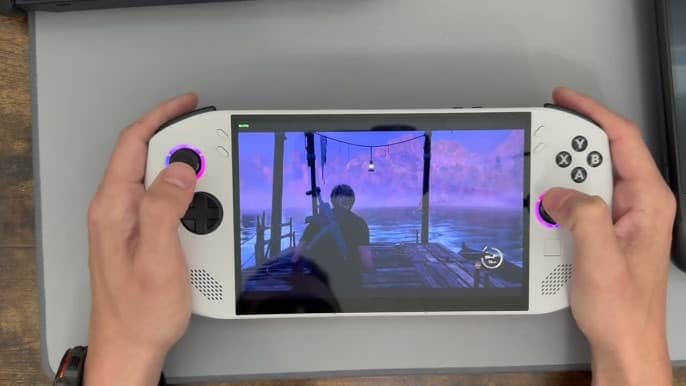
The Legion Go S comes in two appealing colorways: a sleek white and a standout nebula blue. Designed with comfort in mind, it features hall-based analog sticks and triggers for accurate input. Programmable macro buttons and dual front-facing stereo speakers further elevate the gaming experience, while RGB lighting adds a touch of personalization that many gamers appreciate.
However, it isn’t without its drawbacks. The compact trackpad, although functional, can be a bit limiting when precision is needed. Weighing in at 730 grams, it’s heftier than competitors like the ROG Ally and Steam Deck OLED. Still, its balanced weight distribution and comfortable grip can make longer gaming sessions more bearable, helping mitigate the impact of that extra weight.
Performance and Gaming: Real-World Results
When it comes to performance, the Legion Go S packs a punch that can stand tall against other devices using the Ryzen Z1 Extreme, such as the ROG Ally. With customizable TDP settings that range from 7W to 40W, you can fine-tune performance and battery life to suit your gaming style. Benchmark results tell a compelling story: with scores of 2353 (single-core) and 12,029 (multi-core) in Geekbench 6, and 3,481 in 3DMark Time Spy, it’s clear that this device means business.
In real-world gaming scenarios, it shines brightly. For instance, “Cyberpunk 2077” runs smoothly at over 70 FPS at 1200p resolution with FidelityFX Super Resolution (FSR) enabled and a 25W TDP. Similarly, “Forza Horizon 5” achieves over 90 FPS on medium settings with comparable settings. For those engaging with less-demanding indie games, lower TDP settings can stretch battery life considerably, making it adaptable for a variety of gaming experiences.
Battery Life: A Performance Trade-Off
Battery life is one of those crucial elements we can’t overlook when it comes to handheld gaming devices. The Legion Go S offers acceptable performance, but it does have its limitations. At a 7W TDP, it can manage around 5 hours and 30 minutes during lighter gaming sessions, but for more intensive AAA titles at 25W TDP, you might find yourself with just about 1 hour and 30 minutes of gameplay. While the quick-charging 55.5Wh battery does help, a larger capacity would certainly go a long way in enhancing usability—especially for gamers who prioritize those high-performance experiences.
Software and Features: Tailored for Gamers
Running on Windows 11, the Legion Go S provides a familiar interface that caters both to gamers and productivity users alike. For fans of Linux, it also supports Steam OS, allowing for versatility in your software choices. A standout component is the Legion Space software, which lets you tailor performance settings, resolution, and controller configurations to your heart’s content. With a quick menu for on-the-fly adjustments, you can ensure optimal performance no matter what genre you’re diving into.
Competitors and Market Position: Areas for Improvement
While the Legion Go S is a strong performer in many respects, there are definitely areas that could benefit from some fine-tuning. The small trackpad can limit usability for applications that require precision, and its battery capacity could use a boost to keep you gaming longer at high-performance levels. A slightly thicker design to accommodate a larger battery without sacrificing other features could help balance things out, and further enhancement of its software offerings could elevate the overall user experience.
What stands out here is the Lenovo Legion Go S’s ability to deliver power alongside versatility in the handheld gaming market. While it does face challenges related to battery life and usability, its strengths in performance, design, and gamer-centric features make it a compelling option. If you’re someone who values power, customization, and an immersive gaming experience, the Legion Go S is definitely worth considering.