






Reviews
Namecheap: An In-Depth Look at Their Web Hosting Service

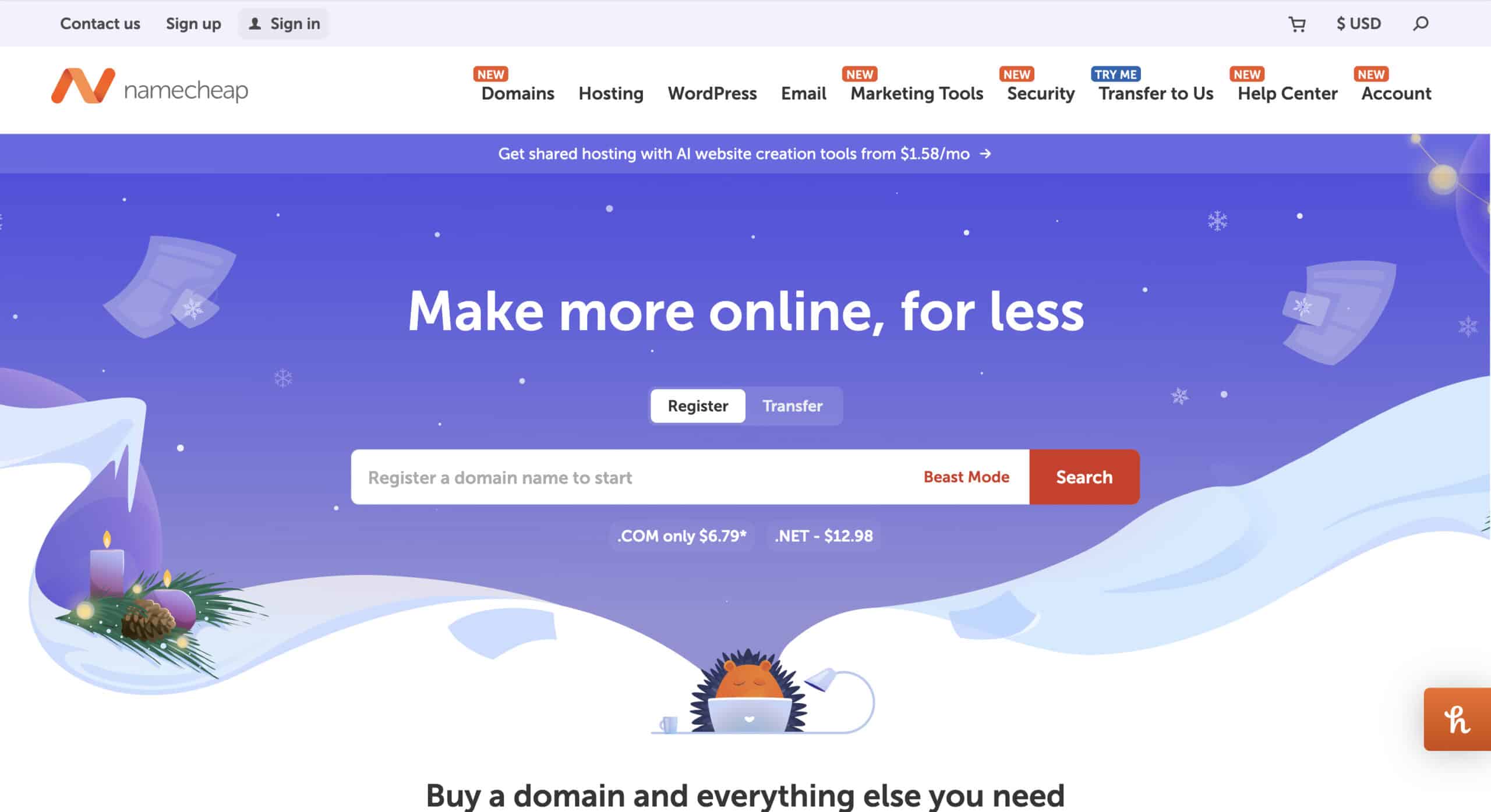
Namecheap stands out as a leading domain registrar, where you can conveniently find and acquire any desired TLD, including .com for your website. As reported by Domainstate, it manages over 14 million domains, trailing only GoDaddy.
However, Namecheap offers more than just domains. The company has been steadily expanding its portfolio with top-notch web hosting products, catering to a wide range of users—from budget-conscious newcomers to demanding business clients.
Recent innovations include Namecheap’s content delivery network (CDN), which boosts website speed for visitors globally. Additionally, they provide an affordable VPN to ensure your safety on public Wi-Fi and to access region-restricted content.
Namecheap subscription options:
- 12 month plan – $1.98 per month ($23.76 total cost)
What types of hosting options does Namecheap provide?
Namecheap’s offerings begin with budget-friendly and user-friendly shared hosting, making it an ideal choice for beginners and less demanding websites. Discounts through Namecheap promo codes can make these options even more accessible.
Furthermore, Namecheap presents EasyWP, a managed WordPress hosting alternative complete with essential site management features and enhanced resources for better speeds. For those seeking greater power and flexibility, Namecheap also offers VPS and dedicated hosting.
Namecheap shared hosting
Enroll in a shared hosting plan, and your site shares a server with multiple others. This setup is cost-effective because server expenses are divided among several accounts. However, it can affect speed and reliability. Utilizing shared CPU, RAM, and network bandwidth may lead to disruptions, especially if other sites on the same server experience traffic spikes. While there’s no evident overload in Namecheap’s shared hosting services, it’s important to consider this when opting for shared hosting.
Namecheap’s shared hosting prices appear exceptionally low, starting at just $1.98 per month for a two-year commitment ($4.88 upon renewal).
Sign up for the TechRadar Pro newsletter to receive essential news, insights, features, and guidance for your business’s success!
Core features include a complimentary domain, free migrations, a bundled website builder, unlimited bandwidth, and regular backups twice a week. Softaculous is integrated for quick installations of WordPress and over 150 other applications, while cPanel provides comprehensive management capabilities for your web space.
Even the most economical plan allows you to host three websites, whereas most providers only permit one on their introductory shared plan.
All shared hosting packages come with 50 free SSL certificates for the first year. If you prefer not to invest the $6.99 annually for renewal, cPanel still provides an option for free SSL.
Prices before and after renewal (1 year plan)
| Plan | Starting price | Renewal price |
|---|---|---|
| Stellar | $1.98 | $4.88 |
| Stellar Plus | $2.98 | $6.88 |
| Stellar Business | $4.98 | $9.88 |
Namecheap WordPress hosting
WordPress is a widely used platform for website creation, powering more than 40% of all global sites. While it offers a user-friendly interface for beginners, it’s also robust enough for large business websites and advanced online stores.
Namecheap’s EasyWP plans might be pricier than shared hosting options, but they deliver more resources and are specifically optimized for enhanced WordPress performance, boasting speeds that are reportedly three times faster than traditional WordPress hosting.
The EasyWP Starter plan provides 10GB of NVMe storage, a complimentary CDN for improved performance, and accommodates a single site with unlimited monthly visitors. It seems appealing at $3.24 monthly on the yearly plan, escalating to $5.74 for renewal. However, note that the SSL is free only for Namecheap domains, which can push costs higher. A Positive SSL for five years is priced at $5.99 and renews at $6.99 annually. For seamless management of all your hosting services in one location, Namecheap is a favorable option, yet if you wish to spread your services across different providers, it may not be the ideal choice.
The other EasyWP plans provide greater storage and resources. The premier EasyWP Supersonic plan is reasonably priced at $6.57 monthly on the yearly plan, increasing to $11.57 upon renewal, while offering the most features.
Some limitations do exist. These plans accommodate only one website, and might not provide the extensive suite of WordPress-centric features available with leading competitors.
For those requiring more robust resources, consider SiteGround’s WordPress offerings, which start at $3.99 per month but provide somewhat limited resources. However, they also come equipped with advanced WordPress and AI-driven tools for additional capabilities.
Namecheap’s WordPress yearly plans
| Plan | Starting price | Renewal price |
|---|---|---|
| EasyWP Starter | $3.24 | $5.74 |
| EasyWP Turbo | $5.16 | $9.57 |
| EasyWP Supersonic | $6.57 | $11.57 |
Namecheap VPS hosting
Virtual Private Server (VPS) hosting provides greater speed and configurability than shared hosting. However, it tends to be more costly and complicated to manage, making it less suitable for novice users with simple, low-traffic websites.
For experts or those with more demanding websites, the scenario changes quickly. A reliable VPS can offer significant control over your server and the capacity to accommodate significant traffic volumes, often at a lower cost than high-end shared hosting.
Namecheap’s VPS offerings initiate at $6.88 monthly, billed annually, for a system featuring 2 CPU cores, 2GB RAM, 40GB NVMe storage, and 1 TB bandwidth (renewal price: $9.88). Though it appears affordable, remember that it’s an unmanaged system, meaning you must handle everything—installing and updating software, restoring servers, and so forth. Control panel access is even excluded.
Managed VPS options are more user-friendly but come at a higher cost. An unmanaged Quasar plan costs $12.88, available monthly, for a 4-core system with 6GB RAM, 120GB storage, and 3TB bandwidth. Total management along with cPanel adds around $54.76 to the overall price (with an additional $1.50 monthly for Softaculous).
For top-tier services, the Magnetar VPS plan boasts 8 CPU cores, 12GB RAM, 240GB storage, and 6TB bandwidth, billed monthly for $28.88 (or $63.76 with the managed option).
The primary advantage of Namecheap’s VPS offerings is affordability. While Hostwinds provides extensive VPS options, Namecheap often surpasses their price point without sacrificing performance.
However, Namecheap’s limited selection—only three VPS plans—may compel you to seek other providers for more customizable options.
For budget-friendly choices, IONOS starts with a VPS plan at $2 per month. Although it’s quite basic (1 core, 1GB RAM), it serves as an excellent introduction to VPS technology.
Conversely, InMotion Hosting’s VPS offerings are abundant with features and stellar support, catering primarily to business-oriented users.
Namecheap’s unmanaged VPS plans post-renewal
| Plan | Starting price | Renewal price |
|---|---|---|
| Pulsar (2 CPU cores, 2 GB RAM, 40 GB storage) | $6.88 | $9.88 |
| Quasar (2 CPU cores, 2 GB RAM, 40 GB storage) | $12.88 | $15.88 |
| Magnetar (2 CPU cores, 2 GB RAM, 40 GB storage) | $24.88 | $28.88 |
Namecheap dedicated hosting
With shared or VPS hosting, you share your web server with several others. However, a dedicated package affords your site exclusive access to the server. Everything from RAM, CPU time, to network connection is reserved solely for your website, ensuring that your site remains consistently performant, free of interruptions caused by other accounts.
Namecheap now offers a more extensive selection, recently expanding to 58 dedicated server options. Prices commence reasonably, below $50 per month for an unmanaged 4-core, 8GB RAM setup, while premium configurations, featuring 16 CPU cores, 128GB RAM, and rapid 4 x 1.92TB SSD NVMe storage, reach approximately $250 monthly. Each plan includes free site migration and a 99.99% uptime guarantee.
As is typically the case with unmanaged systems, the most attractive prices are coupled with the responsibility of managing the server independently. Opting for Complete Management with a cPanel Solo license raises the monthly cost by about $65. This remains exceptionally cost-effective, particularly given that there are no setup fees and the potential for higher prices with other providers.
One drawback with Namecheap is the lack of configurability. You’re unable to customize base servers, such as adding RAM or extra backup drives; what you see is essentially what you get. At present, there are no Windows hosting options, and server availability is restricted to the Arizona data center, ruling out options in the UK or Netherlands.
If special configurations aren’t critical to you and you seek to run a high-traffic or business-essential site where performance and reliability are paramount, Namecheap’s extensive server catalog and competitive pricing merit consideration.
Also, do consider IONOS, which may offer fewer server plans but features some appealing managed and unmanaged options, as well as offerings like Windows hosting on selected servers, and storage servers with up to 48TB capacity.
In contrast, both A2 Hosting and InMotion Hosting present a vast array of managed and unmanaged plans, boasting unique billing flexibility (monthly options available at 1, 3, 6, and 12-month increments). And for those seeking powerful performance, check Liquid Web, renowned for robust servers and its stellar uptime guarantee alongside outstanding support.
Does Namecheap offer a website builder?
If creating your website feels daunting, a website builder could be your solution. Choose a design from a gallery and add content effortlessly through a drag-and-drop interface, which allows for text, images, maps, contact forms, and more.
With its shared hosting packages, Namecheap provides a complimentary website builder, featuring 230 diverse templates designed for various needs (business, blog, food, etc.). The selection of widgets enables the incorporation of a wealth of content types: image galleries, maps, forms, blogs, product listings, payment integrations, and more. It’s a reasonable product—especially for free—and serves as a straightforward alternative to WordPress for basic site creation.
Moreover, Namecheap offers a paid website builder called Site Maker, part of the Visual suite of design tools. By answering a few questions and uploading a few images, Visual can automatically create your site. You can then replace the generic text with your own and utilize predefined blocks for new content, including forms and photo galleries.
Namecheap supports additional free tools, such as logo creation and business card design.
Although this builder may not be the most feature-rich (especially lacking web store capabilities), it is suitable for simple personal sites, and the pricing is competitive. Visual is priced at $3.88 per month, which includes a free SSL certificate, a 99.99% uptime guarantee, and single-site support. Additionally, you can secure a free .contact, .design, or .xyz domain, although top-level domains such as .com and .net must be purchased separately.
Can I establish a web store with Namecheap?
Currently, Namecheap lacks specialized ecommerce products (though the new Visual website builder is expected to offer something soon), but you can certainly establish a web store using any shared, dedicated, or VPS hosting plans from the company.
For instance, signing up for shared hosting grants you access to Softaculous, a robust platform for installing ecommerce systems such as OpenCart, PrestaShop, WooCommerce, among others. Although Namecheap does not provide dedicated store-building tools or support, the learning curve is manageable, especially if you’re familiar with WordPress and WooCommerce.
For simpler options, consider HostGator’s website builder, which includes store-building features. Bluehost’s WooCommerce plans present a versatile mid-range alternative with valuable marketing tools, while Wix delivers excellent templates alongside extensive features.
How fast is Namecheap?
To evaluate Namecheap’s shared hosting performance, we uploaded a pre-built WordPress site and executed core benchmark and load tests, providing an overview of the expected server performance for WordPress sites under increasing user demand.
Reliability also influences a hosting provider’s performance. Namecheap guarantees a 100% uptime for many of its hosting plans, including most shared hosting, VPS, and Dedicated accounts.
WordPress benchmark test (Stellar Business)
| CPU & Memory | Operations with large text data | 4.91 |
| Random binary data operations | 5.28 | |
| Recursive mathematical calculations | 3.61 | |
| Iterative mathematical calculations | 6.84 | |
| Filesystem | Filesystem write ability | 3.6 |
| Local file copy and access speed | 4.85 | |
| Small file IO test | 8.59 | |
| Database | Importing large amount of data to database | 3.88 |
| Simple queries on single table | 7.38 | |
| Complex database queries on multiple tables | 1.31 | |
| Object Cache | Persistent object cache enabled | 0 |
| Network | Network download speed test | 8.25 |
| Overall | Your server score | 4.7 |
However, Namecheap’s shared hosting performance was not as impressive as anticipated. The overall score of 4.7 did not suffer from any specific performance issue but displayed general deficiencies across multiple areas.
Many other hosts within the economical web hosting segment exhibited similar disappointing performance metrics, especially given the existence of other low-cost options that still deliver high efficiency, such as Hostinger, which achieved an 8.1 in its WordPress core benchmark testing.
Siege test (Stellar Business)
| Concurrent users | 5 | 9 | 15 |
| Transactions | 1677 | 2903 | 4917 |
| Availability | 100 | 100 | 100 |
| Elapsed time | 299.15 | 299.02 | 299.78 |
| Data transactions | 72.19 | 129.47 | 216.13 |
| Response time | 0.89 | 0.92 | 0.91 |
| Transaction rate | 5.61 | 9.71 | 16.4 |
| Throughput | 0.24 | 0.43 | 0.72 |
| Concurrency | 4.99 | 8.97 | 14.97 |
| Successful transactions | 1677 | 2903 | 4917 |
| Failed transactions | 0 | 0 | 0 |
| Longest transaction | 7.25 | 7.16 | 8.95 |
| Shortest transaction | 0.63 | 0.63 | 0.63 |
Despite our initial skepticism stemming from the core WordPress benchmarks, Namecheap displayed surprising resilience during load tests.
As user demands increased, Namecheap’s shared hosting consistently maintained a 100% successful transaction rate with a relatively low maximum transaction duration of 8.95 seconds. Although the overall transaction volume was moderate, these results indicate that Namecheap’s servers can reliably manage increased loads.
Based on these findings, we can certainly endorse Namecheap for those seeking a reasonably priced host that can sustain a steady WordPress website performance.
How user-friendly is Namecheap?
Namecheap’s control panel initially appears somewhat busy, with various lists, sidebars, and icons. However, a brief exploration reveals a logical design.
For instance, domain lists are situated in one area while hosting management tools are in another, making navigation much simpler. The Manage panel of your hosting plan reveals vital information like your disk space and bandwidth limits, server hostname, IP address, data center, cPanel access, stats, settings, and more.
This interface is far superior to many competitors who scatter key features across disparate areas, wasting users’ time in search of necessary tools.
While website management will occupy most of your time, Namecheap also excels here. Unlike providers like IONOS or iPage that introduce proprietary management solutions, Namecheap utilizes widely adopted tools like Softaculous for managing WordPress and cPanel for organizing domains and emails.
This is advantageous for several reasons. First, these tools are recognized for their quality (evidenced by their popularity). Second, they simplify tasks for users. If you have experience with cPanel or Softaculous, you will find the interface familiar. Moreover, the time spent mastering the basics of cPanel will prove invaluable if you choose to transition to another hosting provider later.
What is Namecheap’s support like?
Namecheap provides round-the-clock support via its website, live chat, and ticket (note: telephone support is not available).
The extensive online knowledge base contains articles arranged in intuitive hosting categories such as email, SSL certificates, domains, and EasyWP (Namecheap’s WordPress suite).
Selecting the WordPress section reveals specific articles, including ‘Getting Started (Dashboard Overview)’, ‘Website Creation’, and more.
The knowledge base is comprehensive yet user-friendly—simply scrolling through the WordPress category showcases frequently needed articles, such as ‘Differences Between Managed and Shared WordPress Hosting’, and tips for improving website security.
For rapid issue resolution, the live chat feature operates effectively. We found representatives responsive: the longest wait was around three minutes, and they provided clear guidance for our inquiries.
While response times for test tickets were slightly longer (approximately 90 minutes), they were still helpful and succinctly summarized the needed information.
The absence of a phone-support option may be a drawback for some, but overall, Namecheap’s support proved effective, particularly considering the low pricing. If this aspect is essential to you, feel free to explore their support site without needing to be a customer; browsing through the articles will offer insight into the service you can expect.
Final thoughts
While Namecheap’s hosting options may lack the power and features of industry leaders, it can be an excellent choice for novices with basic sites, or for businesses leveraging its robust dedicated hosting range.
Despite not offering the fastest speeds, the plans we assessed function reliably even under considerable pressure. Coupled with their comprehensive range of services, Namecheap is a strong contender if you’re seeking dependable hosting combined with a full spectrum of services under one roof.
Namecheap web hosting FAQs
What forms of payment does Namecheap accept?
Namecheap accepts various payment methods, including credit card, PayPal, and Bitcoin.
Does Namecheap have a refund policy?
Namecheap’s refund policy is more intricate than many competitors, containing numerous specific conditions. Its 30-day money-back guarantee applies primarily to most shared and VPS packages, while dedicated hosting plans have a 7-day refund window. Generally, add-on products are not eligible for refunds, with a few exceptions (certain domain renewals can be refunded if requested within five days of purchase).
Although a simpler policy would be preferable, Namecheap’s 30-day refund period aligns with industry standards. For those seeking extended guarantees, providers like HostGator offer 45 days, and InMotion Hosting even extends to 90 days on many plans.
Does Namecheap guarantee uptime?
Namecheap assures a 99.9% uptime guarantee for VPS and reseller accounts, and interestingly, a 100% uptime guarantee for shared and dedicated hosting plans.
For each hour of unplanned downtime in a month, Namecheap compensates with one day of free hosting, up to a maximum of one month.
This guarantee is better than many competitors. While other providers often have 99.9% uptime guarantees translating to around 43.83 minutes of potential monthly downtime, Namecheap allows for a full hour before the compensation kicks in.
Where are Namecheap’s data centers located?
Web hosting companies maintain their servers in data centers worldwide. Ideally, a good host provides an array of data center options, allowing you to select the most suitable location based on your audience.
Namecheap operates data centers in the USA, UK, and Netherlands. Note that an additional $1 fee applies for selecting UK or Netherlands locations on some plans, so read the details in the shopping cart carefully to avoid surprises.
However, if you require hosting solutions for an audience in Asia, you may explore providers with more global data center coverage. For instance, GoDaddy operates in North America, India, Singapore, and Europe.
How can I find my Namecheap IP address?
Knowing your server’s IP address can be beneficial for various tasks, such as linking a domain from another registrar.
To find your IP address, log into your Namecheap control panel (ap.www.namecheap.com).
In the sidebar, click ‘Hosting List’.
Locate your plan in the Hosting Subscription list and select the ‘GO TO CPANEL’ button. The “General Information” section displays your server IP listed as the ‘Shared IP Address’.
What are Namecheap’s nameservers?
For shared hosting plans (Stellar, Stellar Plus, or Stellar Business), use the nameservers dns1.namecheaphosting.com and dns2.namecheaphosting.com.
For additional plans, check Namecheap’s respective support documentation for instructions on connecting a domain to the server.
How can I cancel a Namecheap product?
Log into your Namecheap control panel (ap.www.namecheap.com).
In the left sidebar, click ‘Hosting List’.
To allow a plan to expire at its subscription termination, turn off Auto-Renew.
To cancel a plan immediately, click the arrow next to the ‘GO TO CPANEL’ link and select Manage.
From there, click Cancel Service and complete the necessary steps, ensuring to read everything carefully as there may be important details regarding refunds and subsequent actions.
Where can I find my Namecheap support PIN?
Reach out to Namecheap support for any account-related inquiries, and the agent will request your support PIN, a unique number that validates your identity as the account holder.
If you cannot recall your PIN, log into the Namecheap account panel, hover over (or click) your account name at the top left of the screen. The “Security” section shows your support PIN in the Access area.
To find the Security page directly, click ‘Profile’, then ‘Security’ in the sidebar.