Reviews
Smart Glasses Offer Big Promises but Come with Frustrating Shortcomings

Reviewing a product can sometimes feel like navigating through a maze built by someone whose creative vision is miles apart from your own. Occasionally, it’s the hardware quality that leaves you wanting; at other times, it’s the philosophy that underpins the design. This is precisely the conundrum I found myself in while testing Halliday’s smart glasses. The design choices made by the creators struck me as misguided, resulting in a product that missed the mark in multiple areas. Even Cofounder Carter Hou acknowledged the duality of opinion surrounding Halliday’s vision; while some users rave about it, I regrettably fall into the category of critics.
Halliday burst onto the scene during CES in January, heralding the arrival of its Wayfarer-style smart glasses. The company promised users a product that would remain inconspicuous, featuring no outward-facing cameras or visible sensors, only a minuscule internal display capable of projecting information directly into the wearer’s line of sight. With an AI assistant touted as “proactive” and a touchpad ring for control, the glasses were positioned as lightweight marvels at just 35 grams. At first glance, it seemed like an appealing package.
A Kickstarter campaign launched at the end of January raised over $3 million, with more than 8,000 backers supporting the venture. Having had the chance to test the glasses over the past month, complete with continuous software updates, I was optimistic about the potential of Halliday’s offerings. The company claims final tweaks would resolve early problems, such as inconsistent Bluetooth connectivity, before the product reaches regular consumers.
Despite its ambitions, however, Halliday’s smart glasses do take several ambitious design swings, but they largely miss their mark.
Hardware
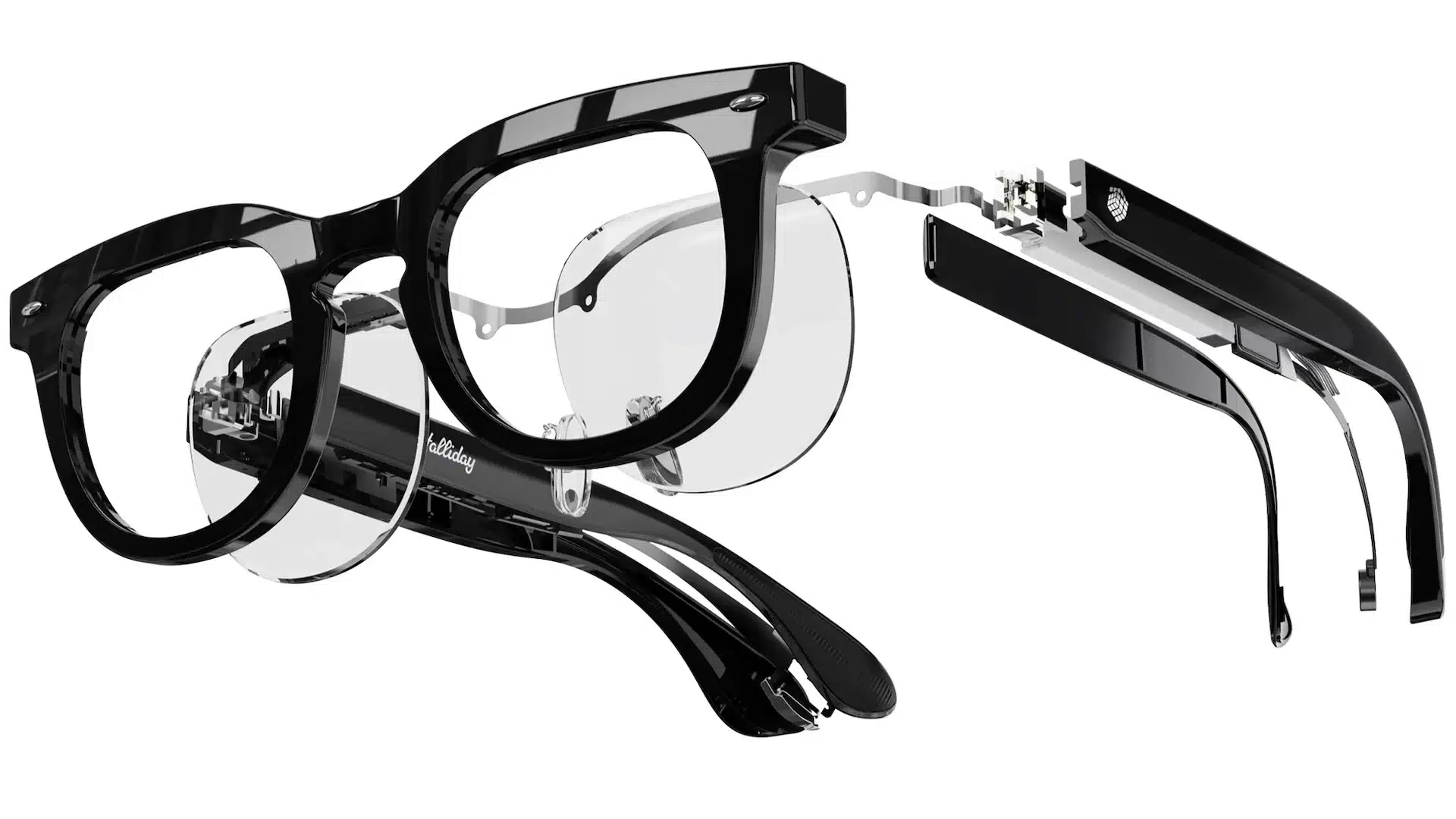
Made from plastic with a basic prescription lens option, Halliday’s glasses certainly present a lightweight solution. Unfortunately, this choice also makes them appear cheap and fragile. The inability to adjust the temple tips results in a one-size-fits-all approach that compromises both fit and comfort; any modifications can only be made by contorting the nose pads during setup.
Key features include a USB-C charging port tucked beneath a rubber gasket on the right temple, flanked by two speakers and a touch surface for controls. A tiny 3.6mm microLED display can be tilted to fit the wearer’s peripheral vision. Despite its intention to be an unobtrusive accessory, the size of the device raises eyebrows, sometimes making them feel more like costume glasses than high-tech eyewear.
Equipped with a control ring available in U.S. sizes 8-15, it also bears a subtle design with minimal markings. However, if not positioned correctly, it can lead to confusion while navigating controls, as the small clickpad necessitates a bit of muscle memory to operate smoothly.
Display
The 3.6mm microLED display aims to trick the viewer’s mind into perceiving a larger screen, mimicking a 3.5-inch display. While the choice of using a bright, monochrome display has its merits, accommodating glasses wearers remains a challenge. The screen being behind your prescription lens complicates visibility, often necessitating eye refocusing before one can engage with notifications, making it especially cumbersome for reading longer texts.
Unfortunately, I found the positioning of the display awkward, leading to frustration rather than ease. Most notably, when attempting to digest lengthier passages or engage with the “proactive” AI feature, I often faced eye strain, an unwelcome side effect of an otherwise innovative concept.
In Use
Setup involves following instructions via the Halliday app, where control is predominantly reliant on the ring. Yet, because of its limited input options, users are confronted with a laborious control scheme. Even a seemingly simple task can turn into a guessing game, particularly if you mistakenly click when a tap is required.
Halliday’s design choices extend to the charging mechanism as well, where the glasses rely on a USB-C port shielded under a challenging-to-access gasket. Moreover, while the control ring charges through a magnetic connection, it adds an extra step to the user experience, complicating an otherwise straightforward process.
Proactive AI
Halliday markets its glasses as equipped with a “proactive” AI designed to assist in real time. While the idea is amusing—imagine having contextual assistance throughout your day—the execution falls short. The system behaves more like a chatbot than a genuine assistant, often responding to every utterance rather than providing meaningful insight. This makes it less of a helpful companion and more of a distraction.
Reactive AI
On the other hand, the reactive AI fails spectacularly at times. Basic inquiries often result in incorrect answers or simply no response. It might be useful for on-the-spot facts, but when those facts are inaccurate, it diminishes the experience significantly. This speaks volumes about the AI’s reliability, and it’s hard to see how consumers could comfortably rely on such technology.
Audio Memo and Transcription
While you can record audio memos through the glasses, the microphone quality is surprisingly poor, producing audio reminiscent of outdated radio technology. Given that voice interaction is a focal point of these glasses, this deficiency raises significant questions about their practical utility. The process of obtaining a transcript equally frustrates as it mandates that you continually monitor a specific pane, further complicating user interactions.
Music
The built-in speakers allow for music playback, technically speaking, but the experience is far from satisfactory. If you’re seeking an immersive sound experience, you’d likely be better served with traditional headphones. As it stands, the audio quality doesn’t rise above rudimentary levels, making it more a novelty than a functional feature.
Price and Competition
Halliday’s smart glasses are set to retail at $499, although backers could snag a discounted price during the Kickstarter phase. Available in Black, Gradient, or Tortoisehell colors, the inclusion of prescription lenses offers an appealing touch. However, it seems steep given the overall performance and quality issues.
In the competitive landscape, alternatives such as Brilliant Labs’ Halo and Rokid’s Glasses pose feasible options, though each carries its own limitations. The higher-end Even Realities G1 delivers more polished features at a premium price, while the Meta Ray-Ban Display glasses offer a richly integrated experience, albeit at $799.
Wrap-Up
In sum, while Halliday’s smart glasses attempt to weave innovative technology into everyday life, they ultimately fall short in both hardware and software. The ambition to introduce a proactive AI capability is a intriguing concept but translates into little more than a chatbot that overwhelms the user. Unfortunately, what could have been a groundbreaking accessory is marred by design and practical flaws, serving as a reminder that even the most aspirational ideas can falter when executed poorly.